Lagalou: To Get Things Done With Feeling
By Peter Berg
from www.planetdrum.org (Join as a member!)
© 2006
Inhabitants of the Northern Temperate Zone who return from visits to places nearer the Equator are often more relaxed and open to people and events around them. Passengers on airplanes and boats tend to laugh and use their hands more.. They aren´t as likely to react as though they´ve been personally invaded if someone bumps into them. Even more tolerant of crying babies. It's not just a vacation syndrome since this expansive attitude illuminates business as well as tourist trippers whether from North America, Europe, Russia, China or Japan.
The cliché is that more southerly based people are "warmer" but that´s a superficial explanation. It´s not just the warmer climate either. A deeper emotional level must be involved because many visitors actually suffer some degree of reverse culture shock when they return. They can be chilled and constricted by the society they find athome. It requires a certain amount of adaptation to re-enter. Some even feel a powerful antipathy amounting to actual revulsion and dis-identification. They no longer wish to be associated with the mainstream culture that originally nurtured
them.
Travelers to Mediterranean countries can come back with some degree of at least
temporary transformation, but those who go to less industrially developed places in
South America, Africa, Southeast Asia, or elsewhere are liable to be especially
affected. What is the basis for this condition that can threaten previously held values
to the point of wanting to discard them? Does it have significance for societies in
general?
Keeping to just the sentimental level of how "welcoming" or "generous" more
southerly people seem to be won´t provide the answers. A more challenging starting
place would be to look at situations that seem to be uncomfortably different.
For six years I have done ecology work in Ecuador that involves a lot of moving around from place to place. It´s made me acutely aware of the strong physical contrast in roads. Riding in a vehicle there inevitably involves sensing the road surface along the way. Potholes or missing sections, bad repairs with dissimilar materials, cracks, bumps, mud, gravel, dust, rocks ...are continually communicated up from the wheels. Holding on to
something or several different parts of a vehicle simultaneously to avoid smashing
into the roof or dashboard is more often than not an essential part of the ride.
Bouncing around on the seat causes the scenery of bright green tropical forest or
fields of evenly planted banana trees and tall groves of leaning bamboo to jump as
though filmed through a handheld camera while running. Worn springs cause body
jolting that is greater than a traveler from outside may have ever experienced. A
bone-rattling trip in a near terminal condition vintage Land Rover from Quito to a
fantastic remote cloud forest reserva with leafy room-like spaces holding pink and
purple orchids and multitudes of air plants was also unforgettable as a series of
crescendoing mountain road impacts.
Smooth asphalt that is taken for granted in most of the U.S. presents an opposite
experience, really a non-experience. Drivers steer with one hand holding a cup of hot
coffee or a cell phone, even writing in a note pad, with little regard for the tame
surface beneath them. A sensation of the actual road is an unusual and intrusive
event. Roadness simply isn't felt. The street outside my house in San Francisco was
torn up and repaved repeatedly in a frenzy of maintenance over the last year by
invading armies of yellow clanging metal-treaded machines and blank-range firing
jackhammers. Each separate addition of water mains or gas lines or new curbs
required tearing up and then carefully restoring pristinely smooth pavement.
This very non-feel of what´s under the wheels that begins for me upon riding to my house from the San Francisco airport has become through absence of sensation an immediate reminder of huge differences in other expectations. It represents a gaping disparity in services that also exists with electricity, water, telephones, street lights, internet, supplies on store shelves, deliveries ... a list that can easily become much longer. In most places in Ecuador they are liable to be frequently interrupted for fairly long periods.
"Infrastructure" is the common term for the collection of amenities that makes things
function easily. It´s a strictly functional word that over-simplifies what is actually
involved. Those enabling functions such as electricity, piped water and roads
represent a significant part of the labor and expense of living in societies that
maintain them. A great percentage of the human work performed and money paid
goes for them, much greater than their users realize. Vast amounts of salaries, taxes,
tolls, fees, and other charges need to continually pour out like new asphalt. At least a
quarter and often more of an average person's salary—a minimum of one week of a
month's work—pays the bills involved.
To command such enormous outlays of labor and cash there has to be a strong social
agreement about the intention to continue using infrastructures and a need for them to
be constantly operational. People must believe that there are many things that simply
cannot be done without them. This is the underlying factor in panic about "peak oil"
that views the future without petroleum as catastrophic. Infrastructures are not just
functional entities to make a car trip smoother or start a stove burner or access a web
site (all heavily dependent on fossil fuel products). They actually represent powerful
foundational social beliefs, intentions and priorities.
In Ecuador the playing out of social beliefs, intentions and priorities has a different emphasis. Some of the principal considerations are also startlingly different. Things get done but the society is able to manage without industrial style infrastructures. For lack of an existing term to describe this I offer "lagalou". Think of music that helps to move muscles in a complex dance. Ecuadorian society moves along on lagalou.
Families of relatives are extremely important to Ecuadorians. They may be more
important than anything else. One's family is large and can number at least hundreds
of members. Seeing the same eyes or nose or mouth shape shared by dozens of
people can be disconcerting. It is true that there are generally more children per
household making more sisters and brothers, but that isn't the main reason for the
vastly larger size. It is who is included. All grandparents and great- grandparents have high positions of course, but their siblings and more distant relations are also
counted. First uncles and aunts are usually as close as mothers and fathers, and all of the members of the families of their mates are added in. Cousins of any degree may
be as close as brothers and sisters. All of the relatives from both the mother and
father's sides are part of the total. It isn't unusual for someone to catch a name in a conversation and interject, "Did you say Velez? Is that the family of Carlos Velez?
We're related. His uncle is married to my grandmother's cousin."
Families have ultimate lagalou in Ecuador. An extensive family not only provides a
large share of one's comfort and stability, companions and entertainment, assistance
and opportunities, it also gives many otherwise for-pay services. It can feed you and
lend money. It gives you a place to stay and for that reason may also determine where
you travel. If something is needed either to borrow or purchase it commonly first
involves searching among members of the family. It finds mates, jobs, connections,
government positions, and practically anything else. The family has continuing and
over-arching presence. Workers often miss days on a job to help out when family
members become sick. When I told someone that I, as many people in the US, only
had a few close relatives it was taken as though a plague must have destroyed the
rest. I received a genuinely pitying look and was told, "I feel sorry for you." A
memorable symbol of how deep the blood of family relations runs came after a woman
graduated from a university and at a party in her honor was presented with a framed
"diploma" stating her family as the awarding institution. The family wasn't going to
be left out of her matriculation. She keeps it on the wall alongside the official
document.
In comparison, life in industrially developed countries is much more self- contained.
People think of themselves as primarily private individuals and anxiously guard their
personal spaces and lives. Consequently they are completely dependent on supporting
services, and often pay exorbitantly for necessities that are commonly given free of
charge in a society with lagalou.
This isn´t a description of a romantic tropical paradise, and Ecuadorians aren´t
uncritical of the conditions in their country. It only has thirteen million people but
migration to Spain alone has been close to half a million in the last ten or so years
and continues at a high rate. The standard of living ranks in about the middle for all
nations on the planet and the reality of that statistic means that money is in painfully
short supply. (An example of the literal truth of this is when small stores and
restaurants often send someone to another commercial establishment to make change
for a customer's paper note used to pay the bill.) People don't enjoy losing electric
power, water cut-offs, road closures, missing deliveries, short store supplies, bad
roads, or other breakdowns.
When interruptions occur, however, there is less complaining and things continue
with surprising ease. Few commercial establishments are so dependent on
infrastructures that they have to close down. Lagalou takes over. Pre- modern cultural
practices survive just beneath the surface and they re-emerge quickly with little
anxiety. Candles shine from windows in all of the nearby houses when electricity is
cut off. If water stops coming out of the pipes an elaborate alternative system takes
over. Most homes and businesses have large portable water containers on hand that
can be filled at wells. There are cisterns built into the basements of many houses that
can be recharged by water trucks. Buckets appear beside sinks and in bathrooms to
transport water for washing dishes and flushing toilets. Conservation measures such
as soaping up with the faucet off and watering plants with leftover rinse water
automatically come into play.
Another main source of lagalou is the fact that there are two active economic
systems. Money is the basis for only one of them. The other is non- monetary, a kind
of lending and borrowing of goods and services. Family membership may be
involved but usually many circles of friends are included as well. Typically it works
like this. Most city people know or are related to someone in the countryside. When
there is a shortage of money those country connections are visited to augment
supplies of food. City people commonly take buses to travel to the country and
perhaps help out on a farm, returning with various amounts of produce that can
include live chickens, meat, eggs, cheese, vegetables, fruit, and so forth.
When country people come to the city to sell their produce or buy equipment they
can stay with friends or relatives. Some member or other of the households involved
may make trips as often as every week. The whole complex exchange can be
accomplished without using any money except for remarkably low bus fares. People
in the countryside have local arrangements among themselves for trading equipment,
labor and supplies by helping with harvests, borrowing pack animals and machinery,
joining construction projects, and many others. In a similar way city people may trade
health care for house repairs, and so forth.
In industrially developed countries where people lead more isolated lives, the
exchange of money is required for almost all economic functions. When things are
desired that are beyond a person's means they are acquired through credit, and when
money is low it is owed or borrowed.
Lagalou is more than just getting things done. Everything that lagalou does is done
with feeling. Let´s return to the less than comfortable example of experiencing the
road surface. There´s more to be felt than just jolts and shakes by the rows of
passengers holding babies, sacks of fruit, live chickens, bottles of honey, and
mysterious cartons tied with rope. Buses and trucks are much more prevalent than in
more developed places where private automobiles outnumber other forms of
transportation. Buses are extremely cheap, and convivial. On-board Latin dance
music is usually playing. Fellow passengers are helpful with directions. Private
vehicles (both cars and trucks) usually transport more than one person unlike the
pattern in more developed countries. Because the passengers are relatives, friends, or
grateful strangers there is amiable conversation during the ride. Self- _expression is
inevitable. Hands wave as voices rise and laughter erupts. Revelations take place.
Valuable information is exchanged, and business takes place. A ride is seldom just
accomplishing travel to a destination. Because the trip has lagalou you feel the other
passengers along with the road.
Lagalou also operates in the most common forms of trade. Marketplaces are hugely
interactive and feature unusual products and services (haircuts and shoes along with
vegetables). More foods are raw rather than processed and their quality is evident to
the eye and nose. Fresh produce and fish comes from open stalls rather than coolers
with week-old goods. There are different prices for the same item from one stall to
the other, haggling thrives, and deals are made. Even individual shops away from the
main markets usually have some of these same characteristics, and vendors pedal
carts full of vegetables, strings of crabs, baked goods, toiletries, and other necessities
through neighborhood streets.
The difference between lagalou and purely functional infrastructures is inestimable.
Infrastructures are efficient but alienating and inner-directed, like the sound of a
recorded voice instead of a real person. Lagalou is assimilating and outer- directed,
always involving other people and their lives.
It seems obvious that it is desirable to have the kind of advantages that families and
alternative economies possess, and not abandon them for the imagined benefits of
more efficient but impersonal enabling and facilitating services. But is this realistic?
Northern Temperate Zoners usually imagine that Equator dwellers would readily
imitate their model if they could and that only economic disadvantages keep them in
lagalou.
That´s an opinion that may be based more on what has been lost in industrialized
societies than what is still cherished in those that function with lagalou. Families
have shrunk to a minor role. Money and credit are essential. Trade is strictly cash and
carry.
A re-creation of extended familial relationships in another form would be needed to
restore lagalou, and exchanges of goods and services would need a different
foundation. There is a hint of this in "tribes" of friends that support each other.
Mutual childcare groups, living cooperatives and eco-villages also come to mind.
Joining barter clubs, using local currencies, and patronizing worker-owned
collectives or consumer supported farms can substitute for some cash-only
transactions. A greater devotion to restoring natural ecosystems and other features in places closeby to where people live is an undoubtedly helpful practice for overall sustainability. Increasingly expensive energy supplies in fossil fuel dependent societies may accelerate these and other beneficial changes much faster than can be presently
imagined.
The most important element is feeling and for that there are only rare examples at
this point in what must be seen as the over-industrialized Northern Temperate Zone.
For exposure to true lagalou one has to go closer to the Equator where it is still the
music that moves bodies in a dance that gets things done.


 on our way in to hear John Boutte at dba on our birthday.
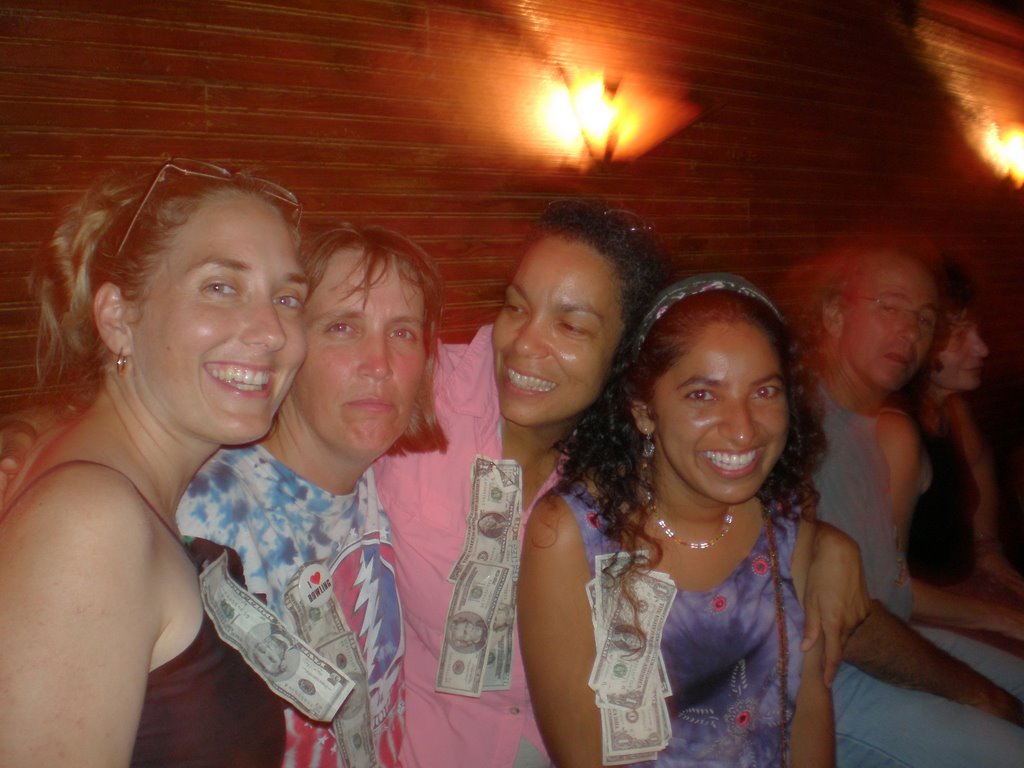 Audrey, Dar, Veda and Nasia- birthdays on September 23 for D,V,N and September 24 for A-note the large amount of money Veda has gathered in the New Orleans birthday tradition (pinned -or stapled in this case- on our shirts by well wishers)- beat us all out by a bunch!